
-
Partager cette page
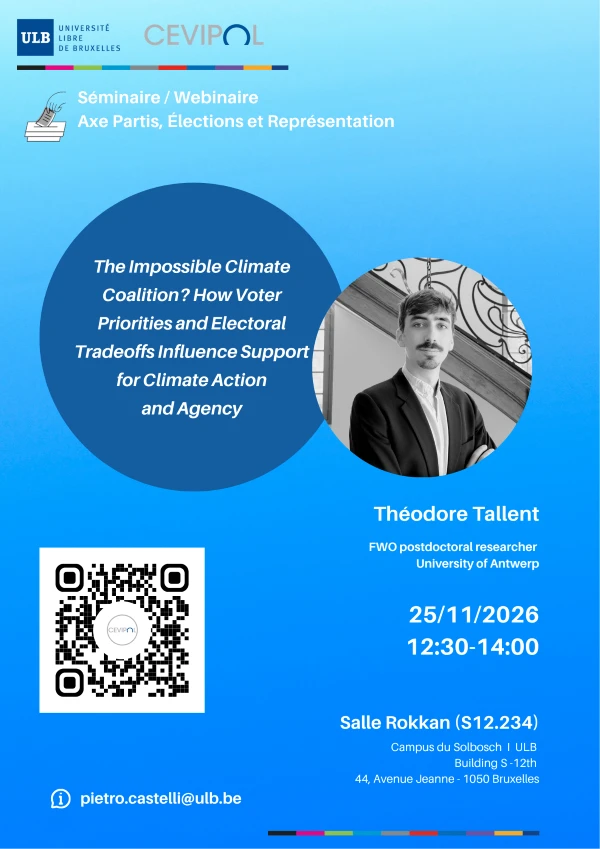
The Impossible Climate Coalition? How Voter Priorities and Electoral Tradeoffs Influence Support for Climate Action
Publié le 18 novembre 2026
– Mis à jour le 18 novembre 2026
Séminaire axe Partis, Élections, Représentation with Théodore Tallent, FWO postdoctoral researcher, University of Antwerp.
Bio
Théodore Tallent is a FWO postdoctoral researcher at the University of Antwerp and an associate researcher at Sciences Po, where he received his PhD in political science in 2026. His research examines the politics of climate change, with a particular interest in how people’s identities, experiences and territorial contexts shape their views on climate policy and, in turn, their political behaviour. His work is published in various journals, including the American Political Science Review, the Journal of European Public Policy and West European Politics.
Abstract
The green transition increasingly generates resistance among a large share of the electorate, as evidenced by limited policy support and even electoral backlash locally. Because this resistance cuts across party lines, climate can act as a wedge issue that splits existing coalitions. But how do voters actually translate their attitudes into electoral decisions when choosing between candidates? And can a party still build a winning coalition around a ambitious - but costly - climate platform? We argue that the answer lies in the multidimensional structure of electoral competition. Voters do not choose on climate alone; they choose between candidates offering bundled platforms on climate and non-climate issues. How they weigh resistance to costly green policies against proximity on other issues determines whether pro-climate candidates win or lose their vote. Based on a candidate-choice experiment conducted in Germany and the United Kingdom, we show that, although most voters tend to electorally sanction costly climate policies, pro-climate candidates can attract cross-pressured voters through non-climate proximity, acting on the trade-offs voters engage with. However, the programmatic requirements for doing so differ across the ideological spectrum, with costly climate platforms being able to assemble only a minority coalition.Date(s)
Le 25 novembre 2026
12:30 - 14:00
Lieu(x)
ULB I Campus du Solbosch
Salle Rokkan (S12.234)
Bâtiment S, 12è étage
44, Avenue Jeanne - 1050 Bruxelles
Contact
Pietro Castelli Gattinara :
pietro.castelli@ulb.be