
-
Partager cette page
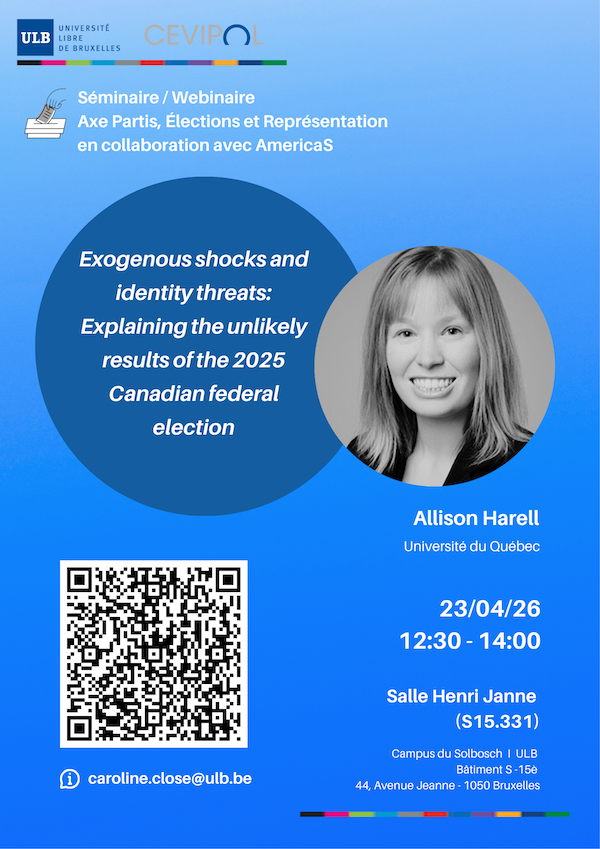
Exogenous shocks and identity threats: Explaining the unlikely results of the 2025 Canadian federal election
Publié le 11 février 2026
– Mis à jour le 8 avril 2026
Séminaire axe Partis, Élections, Représentation with Allison Harell, professor of political science, Université du Québec, Montréal
Bio
Allison Harell is a full professor of political science at the Université du Québec à Montréal. She previously held the UQAM Strategic Chair in the Political Psychology of Social Solidarity, and is a current fellow of the Canadian Institute for Advanced Research. She has worked extensively on how social identities and intergroup relations influence political attitudes and behaviours. She was a co-principal investigator on the 2019, 2021 and 2025 Canadian Election Studies (CES), and currently co-directs the Consortium on Electoral Democracy (C-Dem).
Abstract
The 2025 Canadian federal election marked a dramatic reversal of fortunes for the Liberal Party. While the Conservative Party of Canada (CPC) strengthened its electoral position, the Liberal Party, under new leader Mark Carney, secured a minority government after months in which the CPC had appeared unbeatable. Drawing on data from the 2025 Canadian Election Study (CES) and comparisons with previous CES waves, we argue that the 2025 election is best understood as a case of shifting issue salience that activated perceptions of threat and identity, thereby disrupting “normal” patterns of vote choice among third-party supporters. In particular, attitudes toward the United States assumed unprecedented importance during the campaign. In the context of newly imposed American tariffs and former President Donald Trump’s renewed rhetoric about annexing Canada as a “51st state,” many Canadians expressed a desire for greater distance from the United States. These sentiments disproportionately benefited the Liberal Party. The Liberals under Carney benefited from strong Canadian identifiers, as well as from modest aggregate increases in national identity, and were widely perceived as the party best able to manage the relationship with the United States. More importantly, U.S. threats to Canadian identity led to unprecedented strategic behaviour among third-party identifiers, who rallied to the Liberal brand. Taken together, these findings highlight how evolving issue agendas and identity-based considerations reshaped electoral competition and voter behaviour in the 2025 Canadian federal election.
Date(s)
Le 23 avril 2026
12:30 - 14:00
Lieu(x)
ULB I Campus du Solbosch
Salle Henri Janne (S15.331)
Bâtiment S, 15è étage
44, Avenue Jeanne - 1050 Bruxelles