
-
Partager cette page
10/12/2025 - The Power of Ideas and Discourse in Political Analysis: A Discursive Institutionalist Perspective with Vivien Schmidt
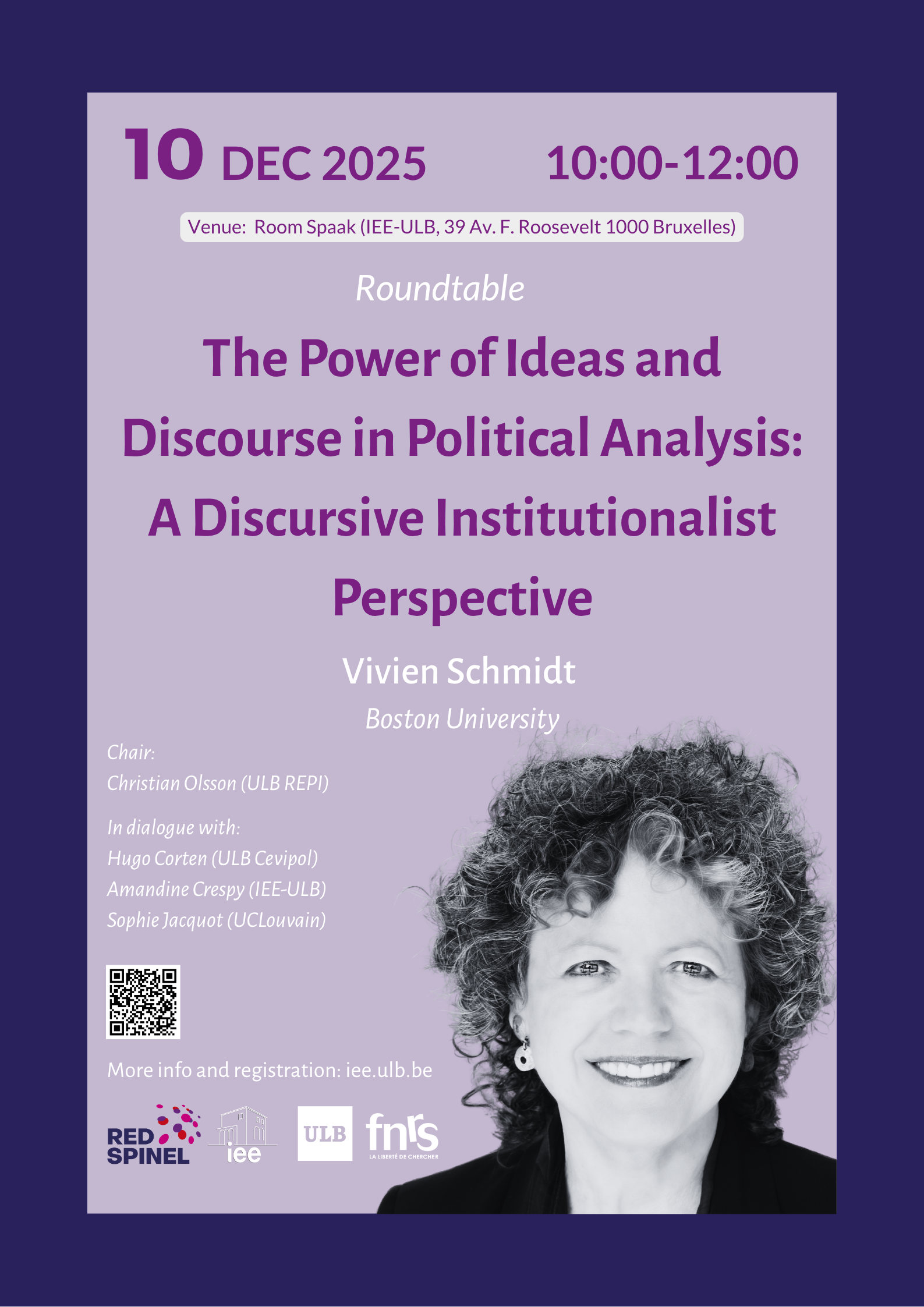 Roundtable: The Power of Ideas and Discourse in Political Analysis: A Discursive Institutionalist Perspective
Chair: Christian Olsson (REPI-ULB)With Vivien Schmidt (Boston University), Sophie Jacquot (UCLouvain), Amandine Crespy (IEE-ULB) and Hugo Corten (ULB)
Registration required
Ideas and discourse are essential to politics as well as to political analysis. In The Power of Ideas and Discourse in Political Analysis, Vivien A. Schmidt provides a sweeping appraisal of the many ways in which scholars explain how ideas and discourse are used both by policymakers and by everyday citizens to understand the world, to influence others, and to mobilize for collective action. In doing so, she also brings together, for the first time in one place, the many facets of her highly original approach to the power of ideas and discourse, developed over the past quarter century under the mantle of discursive institutionalism.
The book covers a great variety of approaches to ideas and discourse across subfields in political science and beyond. It explores the forms they take—from evocative symbols and integrative narratives to overarching public philosophies; the arguments they make—about cognitive necessity and normative values; and the discursive processes they accommodate—from neutral exchange to persuasion or domination.
It considers the discursive interactions in which agents engage—through coordinative discourses of policy construction and communicative discourses of political legitimation—while situating them in institutional context: both external formal institutions and internal constructions of meaning. It delves into the dynamics of change—in policies, programs, and philosophies. It defines ideational and discursive power—persuasive as well as coercive, structural and institutional. It identifies the empirical methods—both qualitative and quantitative—used in such analyses. It also investigates the historical and philosophical underpinnings of these approaches and illustrates them through examples concerning capitalism and democracy, international diplomacy and human rights, conservatism, socialism, and populism.
Schmidt’s masterful book not only serves to constitute the very large field of ideational and discursive approaches falling under the umbrella of discursive institutionalism. As indicated in the subtitle, it also outlines her distinctive Discursive Institutionalist Perspective, highlighting her philosophical premises and methodological preferences while delineating the boundaries with competing approaches, including rationalist, historical, and sociological institutionalism.
Ultimately, Schmidt’s goal is to promote a methodological pluralism that recognizes that, because political reality is complex, it requires a diversity of perspectives—with agents’ contextualized ideas and discursive interactions at its core.
Supported by the Thematic Doctoral School in Political Science affiliated with the F.R.S.-FNRS.
10am-12pm
Institut d'études européennes de l'ULB - 39 avenue F. Roosevelt 1050 Bruxelles
Spaak Room
About the speaker
She is the author or editor of thirteen books and over 300 scholarly publications. Her recent work, supported by a Guggenheim Fellowship, examines the “rhetoric of discontent” driving populist reactions to globalization and Europeanization. Her latest book, Europe’s Crisis of Legitimacy (2020), won major awards from the American Political Science Association and the European Union Studies Association.
Professor Schmidt has been honored as a Chevalier in the French Legion of Honor and elected to the American Academy of Arts and Sciences. She currently holds fellowships at the European University Institute, LUISS Guido Carli University, and the Zoe Institute.